
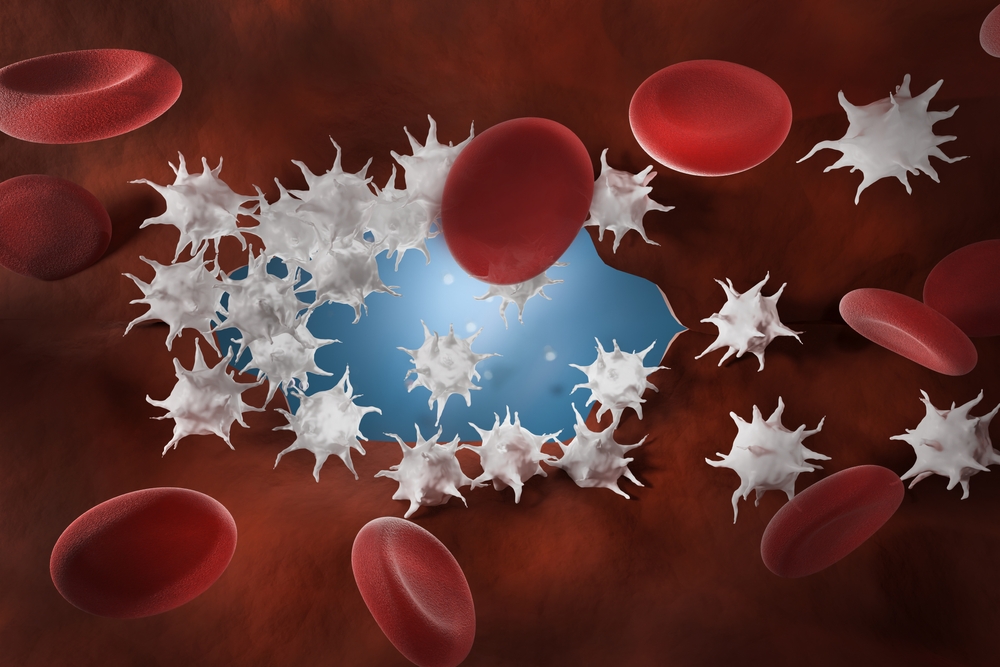
The Activated Partial Thromboplastin Time (aPTT) test measures how long it takes for blood to clot. This is done on a sample of your blood.
If your medical team suspects you may have a clotting or bleeding problem, one or both of two tests are usually ordered. These are:
It is likely that you will also have a Full blood count.
To make your blood clot, your body makes proteins called coagulation (clotting) factors which are activated one after the other. The aPTT test looks at the effects of some of these clotting factors. The PT/ INR test looks at a slightly different set of clotting factors.
If you blood takes longer than normal to clot it is called prolonged clotting. A prolonged clotting time means your blood is not clotting as it should.
How blood clotting works

Clotting (coagulation) factors
Clotting factors are proteins that are made mostly in your liver. They have names, such as fibrinogen and prothrombin. Each clotting factor also has a number, a Roman numeral, such as clotting factor I or II or VIII. For more information on clotting factors and how they make blood clots, go to Coagulation (blood clotting) factors.
The coagulation cascade is the name given to the series of steps by which clotting factors are activated to make a blood clot. There are three main pathways through which clotting factors are activated. These are called the intrinsic, extrinsic and common pathways. These are not real pathways inside the body but naming them in this way helps scientists understand and describe how bleeding occurs.
Clotting factors are referred to as belonging to two pathways:
These join together for the final stage of the clotting process in:
The aPTT test assesses the intrinsic pathway (factors XII, XI, IX, VIII) and the common pathway (factors X, V, II, I). Whereas the PT test assesses the extrinsic (factor VII, tissue factor) and common pathways (factors X, V, II, I).

Each clotting factor plays its own role in clot formation. Each must be working properly and there must be enough of each factor for normal clotting to occur. If there is not enough of one or more of clotting factor, or if the factors are functioning abnormally, then stable clot formation will not take place. This can lead to excessive bleeding and/or clotting.
Also, if there are too few platelets, or if platelets aren’t functioning properly, you may bleed more easily. Too many platelets can increase the risk of blood clots that can block blood vessels and cause deep vein thrombosis, pulmonary embolus, heart attacks or stroke.
How does the aPTT test work?
The aPTT test measures the length of time (in seconds) that it takes for clotting to occur when calcium and other reagents (chemicals) are added to plasma (liquid portion of the blood) in a test tube.
The aPTT looks at clotting factors:
The aPTT is often used as a starting place when looking into the cause of a clotting or bleeding problem.
Your medical team may request a test:
Acquired bleeding and clotting disorders – having an underlying health condition that affects clotting
A range of health conditions can affect clotting. These are called acquired conditions. They usually involve two or more clotting factors. Acquired conditions may involve multiple clotting factor deficiencies that must be separately identified and treated accordingly.
Inherited bleeding and clotting disorders
Inherited clotting disorders are rare and usually involve only one coagulation factor, which may be partly or completely deficient or not functioning properly. Factor testing may be done especially when bleeding episodes begin early in life or when a close relative has an inherited factor deficiency. If an inherited deficiency is diagnosed, other family members may also be tested.
Sample
Blood.
Any preparation?
None.
Your results will be presented along with those of your other tests on the same form. You will see separate columns or lines for each of these tests.
Initial tests will show whether your clotting system is working normally.
If the results of the PT/INR and aPTT tests are not normal, further tests can be used to gain more information. The choice of tests will depend on what your medical team is investigating but you may have some of these tests:
Other tests that are often done at the same time include:
| Results of PT and aPTT results and what they mean for different conditions | ||
| Test results | Possible conditions | |
| PT | aPTT | |
| Prolonged | Normal | Inherited
Acquired
|
| Normal | Prolonged | Inherited
Acquired
|
| Prolonged | Prolonged | Inherited
Acquired
|
Reference intervals - Comparing your results to the healthy population
Your results will be compared to reference intervals (sometimes called a normal range).
If your results are flagged as high or low this does not necessarily mean that anything is wrong. It depends on your personal situation.
As different laboratories use varied reagents for testing of the aPTT, differing aPTT results may be seen across laboratories. As reagents vary in their sensitivities to coagulation factors, it is important to check your specific laboratory’s ranges.
The choice of tests your doctor makes will be based on your medical history and symptoms. It is important that you tell them everything you think might help.
You play a central role in making sure your test results are accurate. Do everything you can to make sure the information you provide is correct and follow instructions closely.
Talk to your doctor about any medications you are taking. Find out if you need to fast or stop any particular foods or supplements. These may affect your results. Ask:
Pathology and diagnostic imaging reports can be added to your My Health Record. You and your healthcare provider can now access your results whenever and wherever needed.
Get further trustworthy health information and advice from healthdirect.